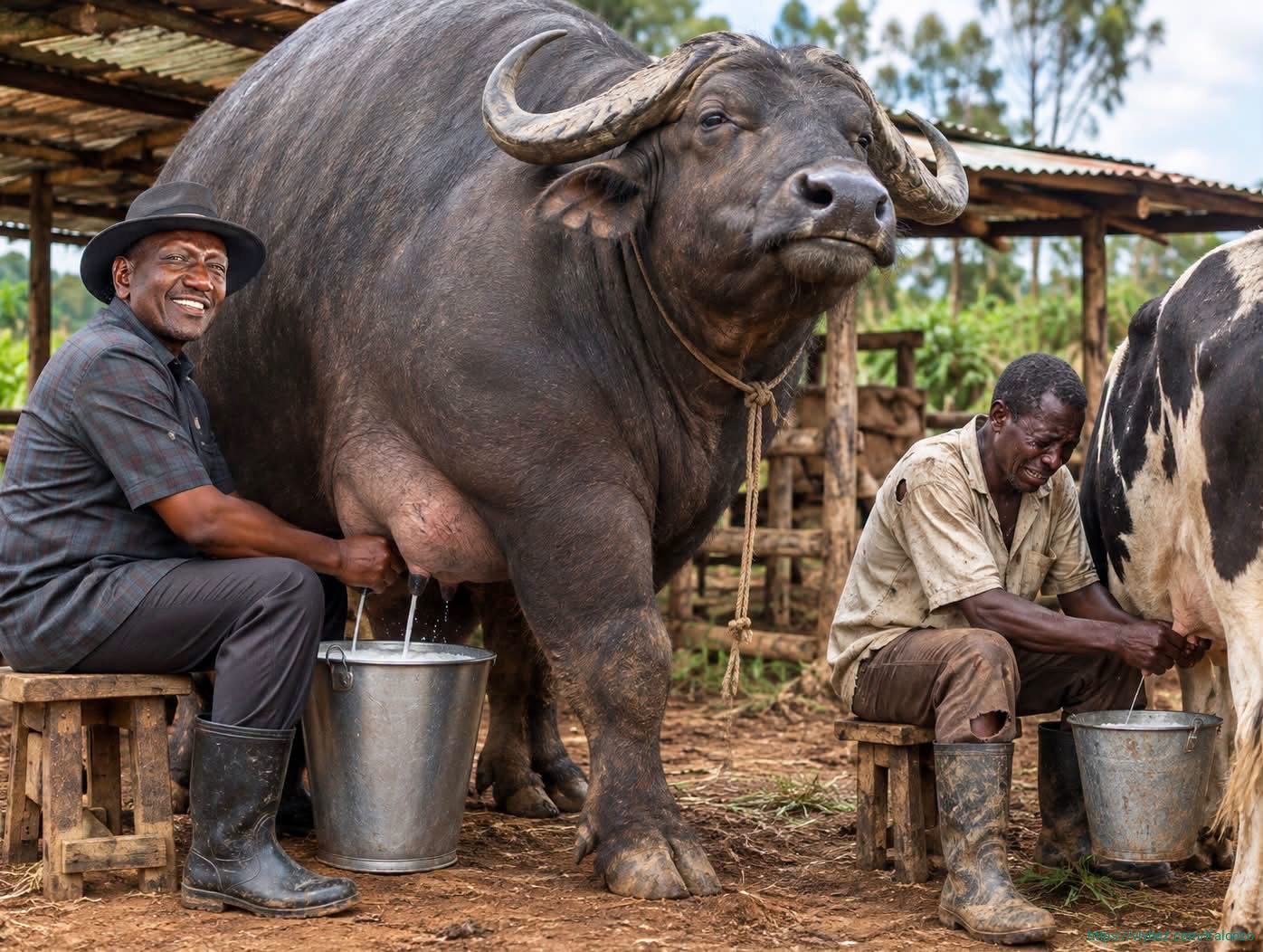
I imagined this buffalo milking business was one of the many pranks William Ruto unleashes on top of campaign cars, until I realised the buffalo has already been gazetted. And here is why I believe our priorities as a country are so misplaced that it is difficult to believe whoever is at the helm is a man who savoured years of intense academic research and got himself a PhD. Because going by his latest buffalo stint, it gives the impression that just the way he is accused of using proxies to amass everything this country prides itself in, someone else possibly sat in the library and wrote that decorated PhD for him. Otherwise, what the hell!
The decision to gazette the water buffalo as a food animal, so the law now allows it to be farmed, milked and slaughtered, came from William Ruto’s visit to India in December 2024. So let’s look at the country we benchmarked from. India has the largest cattle herd on earth, plus about 110 million buffaloes. It is not short of cows. Buffaloes produce about half its milk for very Indian reasons.
First, Indian dairies pay farmers by fat content, so a litre of buffalo milk earns more, and Indians love that rich milk for their ghee. Second, in many Indian states killing a cow is a crime because the cow is sacred to Hindus, so the buffalo is the animal a farmer can sell for meat once it stops milking. Third, buffaloes manage well on straw and crop leftovers from rice and wheat fields, which India produces in huge amounts. And they thrive around rivers, ponds and paddy fields, where they can wallow.
Now ask the Kenyan question. Is our cow sacred? No. Nobody goes to jail for nyama choma. Do our people want very fatty milk? Mostly we want milk for chai and the children. Do we have rivers and paddy fields across the dairy belt? No. So which of India’s reasons applies to us? None. We are copying the answer without reading the question.
On 8 October, at Jamhuri Showground, William Ruto told farmers that Kenya is now Africa’s largest milk producer, at 5.6 billion litres a year. Only a month earlier, his own Trade CS admitted we cannot meet our milk demand and are importing from Uganda. So how does Africa’s biggest milk producer end up queuing at its neighbour’s border, and why does it suddenly need a new animal? Uganda, with an economy far smaller than ours, produces about 5.4 billion litres a year without a single buffalo. What it has is about 145 processing plants that turn extra milk into powder and long-life milk for export. A poorer neighbour solved this with factories and planning, and our answer is to go shopping in India for an animal that will take years to give its first litre.
In April this year, farmers in Kajiado were pouring milk on the ground because buyers were offering almost nothing. Prices fell from Sh70 a litre in the dry season to about Sh50. The farmers asked for cooling plants and training to make yoghurt and powder, but the government turned a deaf ear.
Between January and April, there was so much milk in this country that farmers were literally pouring it away. Just five months of drought later, here we are proposing the water buffalo to help with a milk shortage, and funnily enough, a section of people think it is a brilliant idea. Either I am the one who is mad, or there is just too much madness in this country, because honestly, what problem will these imports solve that better support for existing farmers cannot solve more cheaply?
Water buffaloes, as the name suggests, need water, otherwise they cope badly with heat. They have fewer sweat glands than cows, so they cool off by lying in water or mud for hours, and research shows heat cuts both their milk and their breeding. Even Kenya’s own veterinary officials admitted, when the animal was gazetted, that it needs a lot of water and could compete with local animals for food and space. Now remember why we have a shortage today: drought. So the President’s answer to a drought is an animal that needs a pond, in a country where roughly four-fifths of the land is dry or semi-dry. Where exactly will these buffaloes bathe?
We are not short of good ideas at home. We are short of a government that finishes what it starts. The plan to blend maize flour with sorghum, millet and cassava, and cut our maize imports, was drafted under Jubilee in 2018 and fizzled out. Kenya Kwanza revived it in 2023 and promised millers would start blending that November. Go and buy a packet of unga today. It is still plain white maize. We have not even fully embraced goat and camel milk in most parts of the country. If blended flour, made from crops we already grow, could not survive eight years of policy papers, why should anyone believe a foreign animal will?
Before salivating for tenders to import buffaloes, the government should look at the small farmers with two or three cows who produce about 80 per cent of our milk, the same people who paid our school fees and who poured milk in April and are selling cows in September