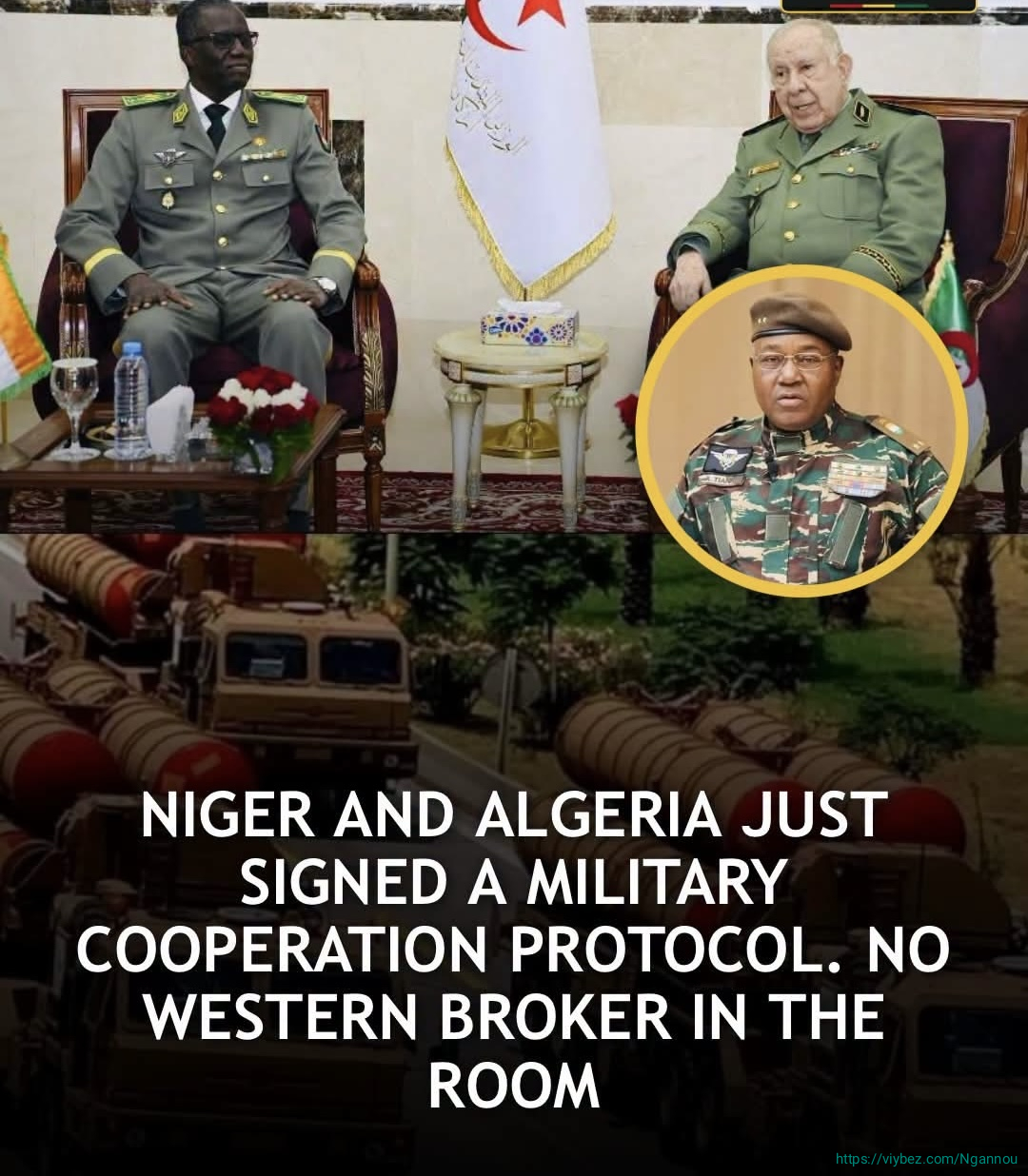
Niger's Defence Minister, General Salifou Mody, flew to Algiers on Wednesday and signed a military cooperation protocol with Algeria's army chief, General Saïd Chanegriha. The ceremony took place at the headquarters of the People's National Army. There was a flag salute, national anthems, and military honours .
The protocol is not a public document. Neither side disclosed its contents . What Chanegriha said in the room is on the record: the Algerian army is "prepared to consider any Nigerien proposal to advance bilateral cooperation" in line with the two countries' interests . Mody praised the "multidimensional coordination" between the two armies .
This is not a first step. It is the formalisation of a partnership that has been deepening for months. Algeria sent four Sukhoi Su-30 fighter jets and a refuelling tanker to Niamey after the August mutiny. It delivered helicopters and ammunition earlier. Niger's prime minister visited Algiers in August. The two countries share a 950-kilometre border and a common interest in containing the insurgency that has bled the Sahel for a decade.
The significance is not in the protocol's unpublished clauses. It is in who is absent. France has no ambassador in Niamey. French troops were expelled in 2024. The United States has sanctioned Niger. The West is watching from the outside while two African armies sign defence agreements on their own terms .
Algeria is not a neutral party. It has its own security interests, its own uranium and gas reserves, and its own rivalry with Morocco. It is not offering charity. It is building a sphere of influence. But it is doing so as an African state, with an African partner, without asking permission from Paris or Washington.
That is the shift. The Sahel's security architecture is no longer designed in Western capitals. It is being built in Algiers, Bamako, Ouagadougou, and Niamey.
#Niger #Algeria