Sign Up
africa
4 people talking about this
Thanks for the tip
Amarachi Okonkwo
Offline
a month ago
Copy Post URL
Open in a new tab
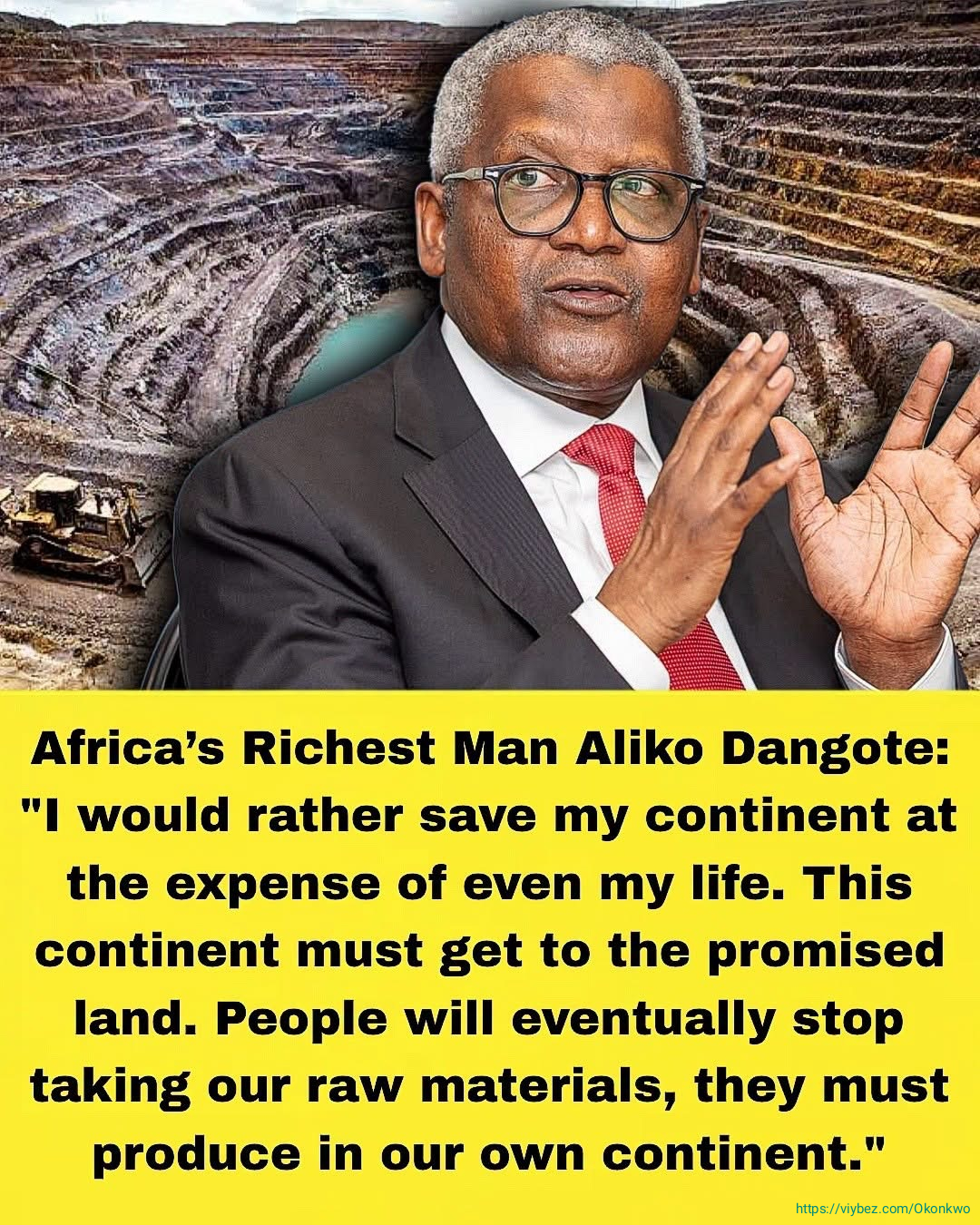
Africa's richest man Aliko Dangote Declares He’d Sacrifice His Life to Save Africa “This Continent Must Reach the Promised Land” - In a powerful new interview with Al Jazeera’s Talk to Al Jazeera, Africa’s richest man, Aliko Dangote, delivered one of his most passionate statements yet on the continent’s future.

“I would rather save my continent at the expense of even my life. This continent must get to the promised land. People will eventually stop taking our raw materials they must produce in our own continent,” Dangote said.

The billionaire industrialist, President of the Dangote Group, framed his massive investments including the landmark $20 billion Dangote Refinery as part of a larger mission: ending Africa’s role as a mere exporter of raw materials and importer of finished goods.

Dangote argued that shipping unprocessed resources abroad simply exports jobs and imports poverty. He insisted Africans must take the lead in processing, refining, and manufacturing on the continent itself so that value is retained at home.

The comments come as Dangote continues to push for greater energy independence, local industrialisation, and a shift away from over-reliance on foreign investment and imports. He has repeatedly said Africa can no longer wait for outsiders to develop it Africans must lead, and others will follow.

The full interview also covers the challenges of building the refinery, plans to expand capacity, listing the company to create broader wealth, and his rejection of monopoly accusations, saying his goal is simply to make Africa great and self-sufficient.

Dangote’s words are already resonating widely across social media as a bold call for African economic sovereignty. #Dangote #Africa
Nyakundi
Offline
2 months ago
Copy Post URL
Open in a new tab
🚨 MIRU SYSTEMS: A GLOBAL ELECTION-TECHNOLOGY COMPANY FACING SERIOUS QUESTIONS OVER ITS TRACK RECORD

South Korean election-technology company Miru Systems, founded in 1999, has supplied or deployed election technology across a number of countries, including South Korea, Kyrgyzstan, Ecuador, Russia, Iraq, the Democratic Republic of Congo (DRC), the Philippines, Fiji, El Salvador and Guinea-Conakry. Miru itself lists these countries among its international election projects, while its current corporate history also identifies major projects in Iraq, DRC, Kyrgyzstan, Russia and the Philippines.

But its international record has attracted significant scrutiny.

🇨🇩 DRC: Miru's election technology became the subject of major concerns over reliability, security and ballot secrecy during the 2018 electoral process. A former Congolese prime minister also filed a complaint against Miru with the Korean National Contact Point under the OECD Guidelines.

🇮🇶 IRAQ: Miru secured a major contract to supply electronic vote-counting equipment for Iraq's elections, with the deal reportedly worth about US$100 million. The country's subsequent electoral process faced serious disputes over vote-counting technology and results.

🇵🇭 PHILIPPINES: Miru won an almost ₱18 billion contract to supply an automated election system for the 2025 elections, including approximately 110,000 automated counting machines. The contract attracted scrutiny from election watchdogs because of Miru's previous international record.

🇿🇲 ZAMBIA: Miru has also been involved in the country's voter-registration technology procurement ahead of the 2026 elections. Transparency International Zambia raised serious concerns about the procurement process and cited Miru's controversial record in previous elections.

🇦🇷 ARGENTINA: Miru technology was also associated with proposed electronic voting systems for Argentina, while reporting at the time raised questions about the procurement and subsequent use of the technology.

The broader international footprint includes Kyrgyzstan, Ecuador, Russia, Fiji, El Salvador and Guinea-Conakry, according to Miru's own company history and corporate materials.

⚠️ Important: These controversies do not by themselves prove that Miru Systems rigged elections. However, the documented disputes, technical concerns, procurement controversies and scrutiny surrounding some of its deployments raise legitimate questions about transparency, cybersecurity, independent auditing, source-code access, procurement integrity and safeguards against manipulation.

The question every country using election technology should be asking is simple:

Who independently audits the system?
Who can verify the source code?
Who controls the technology?
And what happens when the system fails?

🗳️ Election technology should never be trusted blindly. It must be independently tested, auditable and verifiable.

#MiruSystems #ElectionIntegrity #ElectionTechnology #Democracy #Africa #Zambia #DRC #Iraq #Philippines #Kenya
Jackson Barasa
Offline
2 months ago
Copy Post URL
Open in a new tab
# Tanzania’s 2,115MW Julius Nyerere Hydropower Project Set for Official Inauguration

**Tanzania is preparing to officially inaugurate the massive Julius Nyerere Hydropower Project on Saturday, August 22, marking a major milestone in the country’s push for greater energy security and industrial growth.**

Built on the Rufiji River, the project has an installed capacity of **2,115 megawatts**, generated through nine turbines. The project includes a huge reservoir designed to store water and support reliable electricity generation.

The scale is remarkable.

**2,115MW is slightly more than Uganda’s entire installed electricity-generation capacity of about 2,098MW.**

The Julius Nyerere project has already become a major contributor to Tanzania’s electricity supply. According to Tanzania’s Energy Ministry, it accounted for **44.9% of all electricity generated and fed into the national grid in the year ending May 31, 2026.**

President **Samia Suluhu Hassan** is expected to officially inaugurate the project on August 22, with the government describing it as a landmark investment aimed at strengthening Tanzania’s power supply and supporting production, investment and economic growth.

### Why this matters for East Africa 🇹🇿

More reliable electricity could give Tanzania a major advantage in:

🏭 Manufacturing and industrialisation
⛏️ Mining and mineral processing
💼 Business and investment
🏠 Household electricity access
🚆 Infrastructure development
🌍 Regional electricity trade

The project could also strengthen Tanzania’s ability to participate in regional power markets as East African countries increasingly connect their electricity grids.

But the real test is not simply how many megawatts a country can generate.

The real test is how effectively that electricity is transmitted to factories, businesses and households—and whether abundant power translates into cheaper energy, more jobs and faster industrialisation.

Tanzania has now put a massive amount of generating capacity on the table.

The next question is: what will Tanzania build with all that power? 🇹🇿⚡

#Tanzania #JuliusNyerere #Hydropower #Energy #EastAfrica #Africa #Industrialisation
Martin Ondieki
Offline
2 months ago
Copy Post URL
Open in a new tab
UGANDA IS BUILDING TOWARDS AN OIL-POWERED INDUSTRIAL FUTURE — AND KENYA SHOULD BE WATCHING.

Uganda's long-awaited US$4 billion oil refinery project is moving forward, with basic engineering work already underway and a Final Investment Decision now expected in February 2027.

The planned Kabaale refinery in Hoima will have a capacity of 60,000 barrels of crude oil per day and will be supported by pipelines, storage facilities and a water-supply system.

The ambition goes beyond simply producing fuel.

Reduce dependence on imported petroleum products
🏭 Supply fuel and other products to local industries
💰 Generate government revenue
⛽ Develop domestic refining capacity
🚛 Support petroleum storage and distribution infrastructure
🌍 Create opportunities to supply regional markets

Uganda's strategy is increasingly about capturing more value from its own oil resources instead of simply exporting crude and importing finished petroleum products.

But there is an important reality check:

The refinery is not starting production in 2026. Current projections point to commercial operations around 2029–2030, assuming the project proceeds according to the revised schedule.

This raises an important question for East Africa:

Why should countries blessed with natural resources remain permanently dependent on importing finished products?

Uganda is betting on refining, infrastructure and industrialisation.

The bigger question is whether the region can turn its natural resources into jobs, cheaper energy, manufacturing and lasting wealth for ordinary citizens.

East Africa should be competing to build industries—not just competing to export raw materials.

#Uganda #Oil #Africa #Energy #EastAfrica #Industrialisation #Kenya